
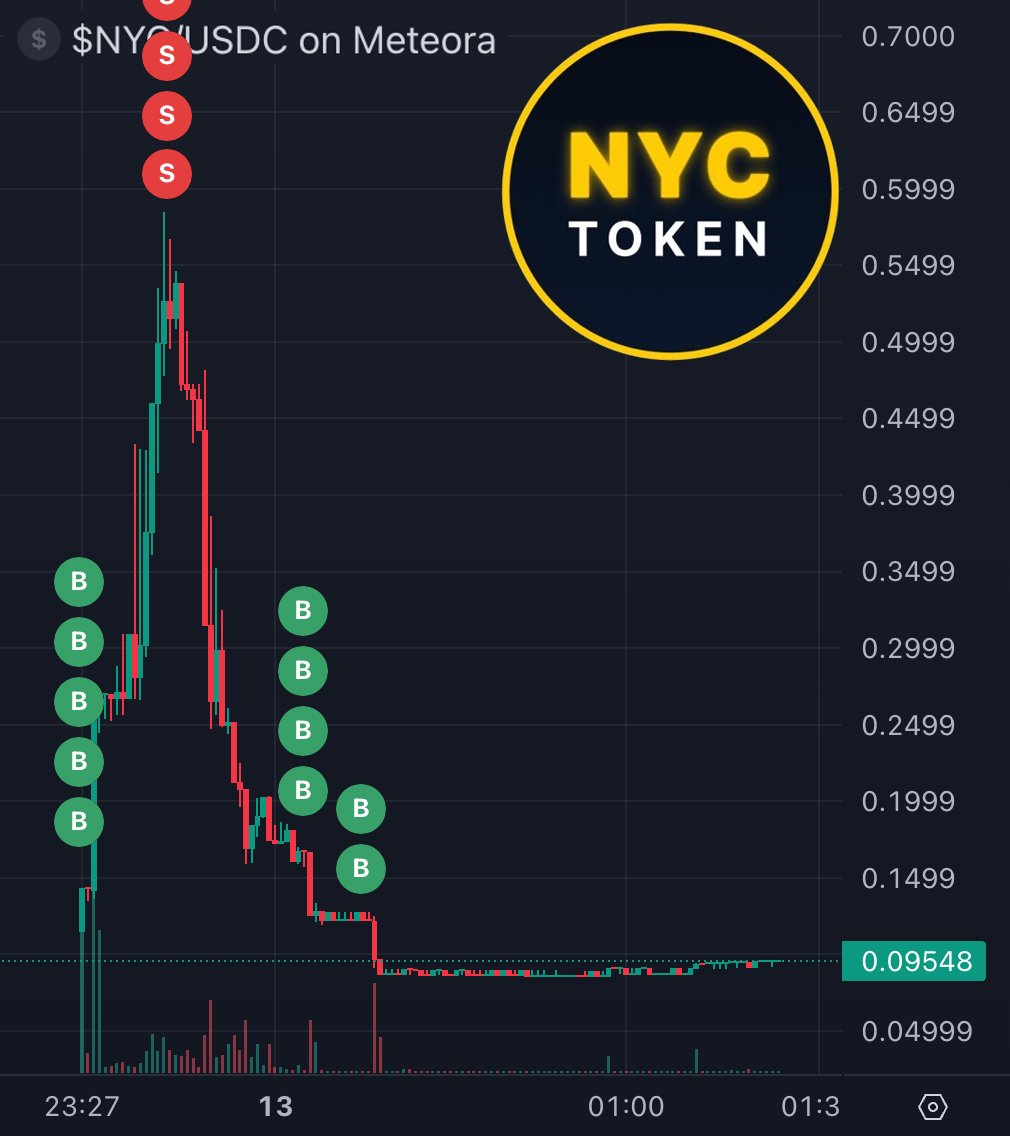
The world of cryptocurrency continues to deliver narratives that defy belief, and the recent events surrounding the NYC token are a stark reminder of this. Investors in the memecoin, controversially linked to former New York Mayor Eric Adams, learned this lesson the hard way on January 12. Within a mere 30 minutes of its launch on the Solana blockchain, the token plunged by over 81%, obliterating an estimated $500 million in peak paper value. What followed was a swift and brazen maneuver that left many questioning the ethics, and indeed, the legality, of such ventures.

A High-Profile Launch and a Swift Collapse
The project itself carried a significant public profile. Just about twelve days after stepping down from his mayoral office, Eric Adams unveiled the NYC token at a Times Square event. He positioned the initiative as a dual-purpose endeavor: to fund blockchain education and to actively combat antisemitism, lending it an air of social responsibility. The launch gained further traction through promotions on his verified X account, an endorsement that likely drew considerable attention. However, this promotion was later annotated by X Community Notes with a stark “rug pull” warning, a clear signal of the trouble brewing beneath the surface. The token briefly soared, reaching an estimated market capitalization between $540 million and $600 million, before its dramatic and rapid descent.
Unpacking the Brazen Mechanics of the Rugpull
On-chain investigators swiftly moved to dissect the events, focusing on liquidity movements and the highly concentrated nature of the token's supply. The findings, particularly from blockchain analytics firm Bubblemaps, paint a clear picture of what transpired. A wallet identified as being connected to the token's deployer executed a critical maneuver: it created a “one-sided” liquidity pool on Meteora, a decentralized exchange, and then proceeded to remove approximately $2.5 million in USDC stablecoin precisely when the NYC token was at its peak price.
This significant withdrawal of liquidity effectively pulled the rug out from under the token's market. Following the initial crash, after the token's value had already plummeted by more than 60%, the same wallet then added back about $1.5 million. This “round trip” transaction left approximately $932,000 in USDC unaccounted for, a substantial sum that disappeared from the liquidity pool at the expense of retail investors. Solscan, a Solana blockchain explorer, corroborated this activity, confirming the deployer-linked account's movements.
Extreme Concentration and Visible Retail Losses
Beyond the liquidity manipulation, analyses highlighted an alarming degree of supply concentration. Bubblemaps' reporting revealed that the top five wallets held an astonishing 92% of the total NYC token supply, with the top ten wallets controlling nearly 98.73%. One single wallet alone commanded roughly 70% of the entire supply. Such extreme concentration means that price discovery was never truly organic; it was dictated by a handful of entities. This structure made the token incredibly vulnerable to manipulation, as a small number of holders could dump large quantities onto the market, causing massive price swings.
The real-world impact was immediately visible in transaction histories. One particular Solscan-tracked wallet exemplified the retail devastation, executing five buy orders totaling 745,725 USDC and then selling for only 272,177 USDC. This single trader experienced a staggering loss of approximately $473,548 in less than twenty minutes. The combination of rapid price decline, a centralized holding structure, and thin, removable liquidity amplified slippage for those attempting to exit their positions on decentralized exchanges, cementing their losses.
“The speed of the drawdown and the centralized holdings structure meant price discovery depended on a thin set of wallets and a small amount of removable liquidity. Those conditions can amplify slippage during exits on DEX venues.”
Here's a snapshot of the immediate aftermath:
- NYC Peak Market Cap: $540M – $600M
- Post-Crash Market Cap: ~$87M – $110M
- Peak Price: ~$0.58
- Crash Price: ~$0.11
- Price Change: Over 81% drop
- USDC Removed from Liquidity (est.): $2.43M – $3.4M
- Time from Peak to Crash: Approximately 30 minutes
Eric Adams' Forays into Crypto
This isn't Eric Adams' first venture into the world of digital assets. He has, for several years, actively linked his political brand to cryptocurrency. As Mayor of New York, he notably arranged to convert his first paycheck into cryptocurrency in early 2022. Earlier, in 2021, he had publicly stated his intention to take his first three mayoral paychecks in Bitcoin, even posting about this pledge on X. His involvement deepened in 2025 with city initiatives and public appearances aimed at increasing crypto visibility. However, his political standing shifted after he lost the Democratic primary to Zohran Mamdani and subsequently left office at the end of 2025. It is worth noting that, in a separate legal matter, a federal judge dismissed a corruption case against Adams with prejudice on April 2, 2025, following a Justice Department request for dismissal.
The Broader Memecoin Landscape and Regulatory Gaps
The NYC token's dramatic collapse occurred against a backdrop of a volatile and often unregulated memecoin market. This incident isn't isolated; other tokens linked to politicians and celebrities have also faced scrutiny for practices like fee extraction, insider allocations, and steep drawdowns. The 81% crash of NYC echoes similar significant declines seen in tokens like TRUMP and MELANIA from their respective peaks.
The wider memecoin market has experienced significant fluctuations. After hitting highs in early 2025, the total market cap for memecoins fell by 61% to around $36.5 billion, only to rebound to $47.3 billion in early 2026. Trading volumes also mirrored this volatility, dropping from about $20 billion in mid-2025 to under $3 billion by December of the same year. On the Solana network, where NYC was launched, 2025 saw a boom in token creation, but a relatively small fraction of these tokens ever achieved sustained trading. This environment means that many attention-driven launches are constantly vying for the same limited retail liquidity, making them susceptible to rapid pumps and dumps.

The regulatory framework surrounding memecoins also plays a crucial role. Current regulatory postures often leave retail investors vulnerable, relying on disclosure choices, platform controls, and general anti-fraud enforcement rather than the stringent disclosure regimes typically associated with securities offerings. A February 27, 2025, SEC staff statement indicated that many memecoins might not involve securities transactions, as they are often purchased for entertainment, social interaction, or cultural purposes. However, the statement also cautioned that fraudulent conduct could still be pursued by other federal or state authorities. Since that statement, public enforcement against memecoin issuers has been limited, though prosecutors have continued to pursue fraud cases in other crypto contexts.
Some states are exploring tailored legislation. New York, for instance, has proposed laws that would define and criminalize certain “rug pull” behaviors based on developer holdings and selling patterns. This would create a distinct legal pathway separate from federal securities theories.
Lingering Questions and the Unaccounted Funds
For the NYC token, immediate and pressing questions remain concerning control and disclosure. Who financed the launch? What agreements were in place for liquidity provisioning and market making? Did the promotional representations made by Eric Adams align with the actual on-chain execution? These questions gain particular urgency given that the deployer-linked liquidity removal occurred precisely at the moment of maximum retail demand. Furthermore, the token's highly concentrated supply meant that its price formation was entirely dependent on a small number of wallets, which had the power to either sell into thin liquidity or withdraw it entirely.
While Eric Adams publicly promoted the token and the official NYC Token account discussed liquidity arrangements on X, neither has provided a detailed accounting that reconciles the approximate $932,000 gap identified in the Bubblemaps analysis.

A New Reality of Digital Deception
This entire saga feels almost too audacious to be true, the kind of narrative one would initially dismiss as a deepfake or elaborate hoax. Yet, it appears to be a chilling reflection of the current digital landscape. If public figures, including former high-ranking officials, can launch such projects, it underscores a profound shift in what is considered possible within the unregulated corners of the crypto world. Unlike a slow, predictable decline in value, the NYC token event was a swift, decisive rugpull, instantly vaporizing investor capital. For US retail investors who bought into both NYC and other politician-linked tokens at launch, the experience is likely to be a demoralizing one, doing little to instill confidence in crypto as a “force for good.”
Post a Comment